When people stop playing sport, they usually stop turning up. That becomes a quiet problem for rural communities like Clermont in central Queensland where plenty of people work drive-in drive-out or fly-in fly-out rosters, making committing to a season genuinely difficult. When someone stops playing they lose a great deal more than the football itself. They lose the training nights, the change room, and the routine of being somewhere every week.
Clubs are often described as being good for the community, which rather undersells what they actually do. For a lot of men in a town like this footy provides the only regular exercise they get and the only real challenge outside work. It is often the one place where they are known well enough that somebody would ask if they seemed off. Losing that connection when they stop playing is not a small thing, and it is not easily replaced.
None of that had really been named as a problem until Clermont lost one of their own. It was a loss that rocked the community, and the conversation that followed was about everyone who was no longer around the club: how you stay in touch with them, how you notice when someone has quietly drifted away, and how a club goes on looking after people once they have stopped pulling on a jersey. The Clermont Bears Old Boys were formed to answer that question.
Why the Old Boys exist
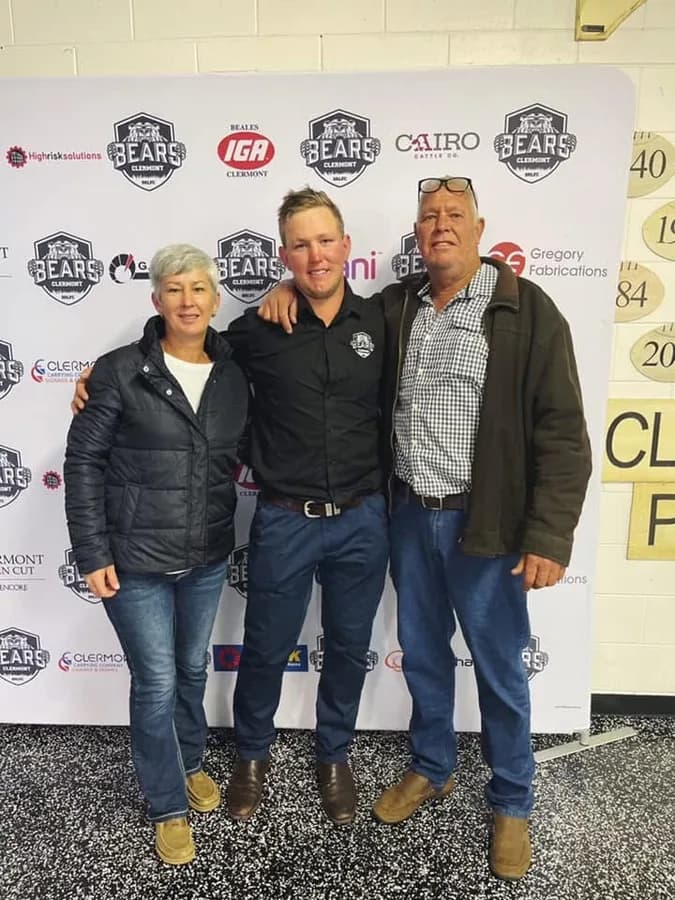
Rhiannon Finger's family had been involved with Clermont Bears Rugby League for years, and when her husband Brendon retired from playing they stepped away the way most families do. The Old Boys are what brought them back, and Brendon is now president while Rhi is secretary.
What began as a way of keeping former players connected has turned into something rather more useful than just a social gathering, because the Old Boys also fundraise. Previously, they raised money to help a former player seek cancer treatment, and this year they went after something different again.
That structure is worth pausing on, because it is unusual and it works. The club runs the football week to week, which is more than enough for any volunteer committee to be carrying, while the Old Boys take on the fundraising. The result adds fundraising capacity to a club without asking anything more of the people already coaching, running the canteen, maintaining grounds and managing club finances.
Trent
Trent White grew up in Alpha, a town of around 550 people west of Rockhampton, before moving to Clermont for work as an apprentice carpenter and playing representative level for the Bears. Footy later took him to Yeppoon and a stronger competition, where Rhi describes him as a force to be reckoned with. He was selected for the Queensland Country side, played against City and was watched by more than one scout, and at 24 he signed with the Melbourne Storm for a train and trial period of twelve weeks in Melbourne.
The Storm have put real resources behind the players going through that process. But a train and trial is not a guarantee of an ongoing position with the Storm, and there is a lot of work ahead for Trent. Relocating to, and living in, Melbourne for twelve weeks also costs money that lands squarely on the player, so the Old Boys decided to get behind him.
100 squares, under 24 hours
Rhi launched a 100 square grid at $100 a square with a $5,000 first prize, which is considerably more than the 20 per cent of the pool that Lucky Squares usually suggests. But the Old Boys wanted to offer a first prize that would get the town's attention. And it did, with thirty five squares selling in the first hour.
"We knew the community would rally behind Trent," Rhi said, "but I couldn't believe we sold 35 $100 squares in the first hour."
The grid sold out in under 24 hours, taking $10,000 in square sales, of which $5,000 went to the winner and $5,000 went towards getting Trent to Melbourne. It is the second fastest 100 square campaign to sell out on the Lucky Squares platform.
If your club has something worth rallying around, you can build a grid and preview it for free before committing to anything.
Rhiannon had previously done this the hard way
None of this was new to Rhi, because she has run 100 board fundraisers before on paper, as recently as a couple of months earlier. Her assessment of that experience is blunt.
"It was an enormous amount of work, messy and time consuming, and it needed someone with time on their hands to drive it behind the scenes, fielding Messenger messages and chasing people for money."
She found Lucky Squares through a Google search and set the campaign up herself, surprised at how simple the process was. "Even my husband, who is technically challenged, said it was easy for someone like him."